
Transaction Monitoring Rule Tuning Workspace — Rabobank
Decision-support prototype for Rabobank's AML RFP — a four-step Tuning Workspace that guides financial crime teams from rule data readiness through governance-ready threshold recommendations.
Rabobank · 2025
Overview
A prototype built for a compliance-critical RFP
- Rabobank needed a demo-ready interface showing how financial crime teams could review and tune transaction monitoring rules without autonomous production changes
- The result: a four-step Tuning Workspace guiding analysts from data readiness through governance submission
- No production threshold changes — every output is a recommendation requiring explicit Rabobank governance approval
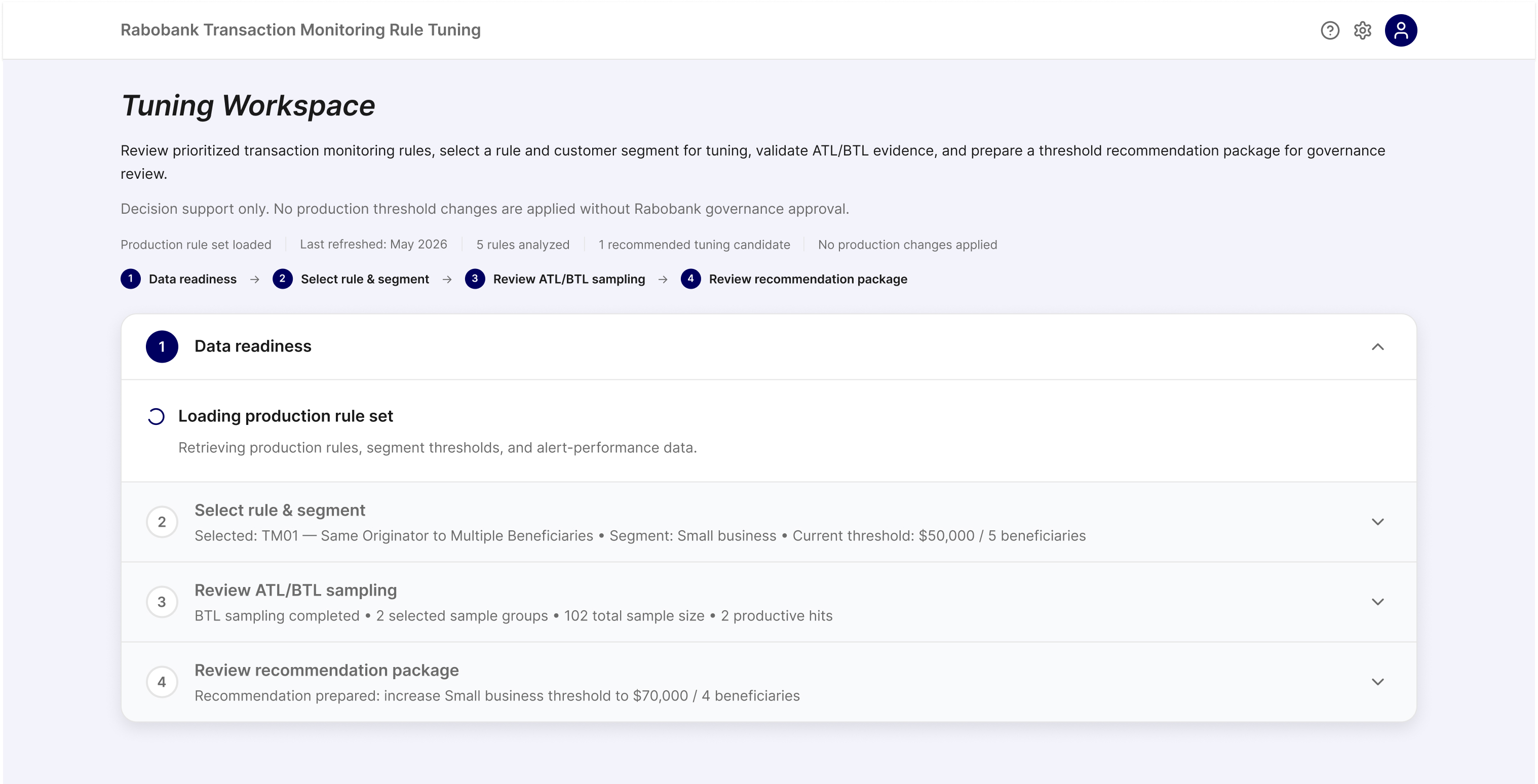
The Tuning Workspace — step 1 loading the production rule set
The Challenge
Seven things users must understand before a threshold changes
Tuning AML rules is manual, evidence-heavy, and governance-sensitive. Users need clarity at each stage, not just a final answer.
What data has been loaded and is ready for analysis
Which rules are candidates for tuning, and why they were prioritized
Which customer segments apply to the selected rule
What ATL/BTL samples support the recommendation
What threshold change is being proposed
What the operational impact would be — alerts, escalations, productivity
That the output is a recommendation submitted for review, not a production change
- Role
- Lead UX/UI Designer
- Client
- Rabobank
- Scope
- RFP prototype — AML rule tuning workflow
My Role
Translating moving requirements into a product story
This was an RFP response. Requirements were still evolving at kickoff: demo data arrived as Excel files, sketches came from multiple SMEs, and the audience in the room was both business and compliance stakeholders. There was no PM on the design side. I defined scope, structured the interaction logic, and delivered screens for a five-minute client walkthrough.
- Work in parallel with evolving SME input — no sequential planning phase
- Navigate the AML transaction monitoring domain fast enough to make credible design decisions
- Keep framing honest throughout: decision support, not AI autonomy
Design Decisions
- Accordion over dashboard — earlier concepts had too many panels; one active step at a time keeps the RFP demo focused
- “Tuning” not “optimization” — SME feedback; more credible in the AML domain
- Data readiness as step 1 — makes the back-end pull explicit in the UI without adding an upload screen
- Governance confirmation as the final state — “submitted” not “done”; reinforces that Rabobank controls approval
Step 2
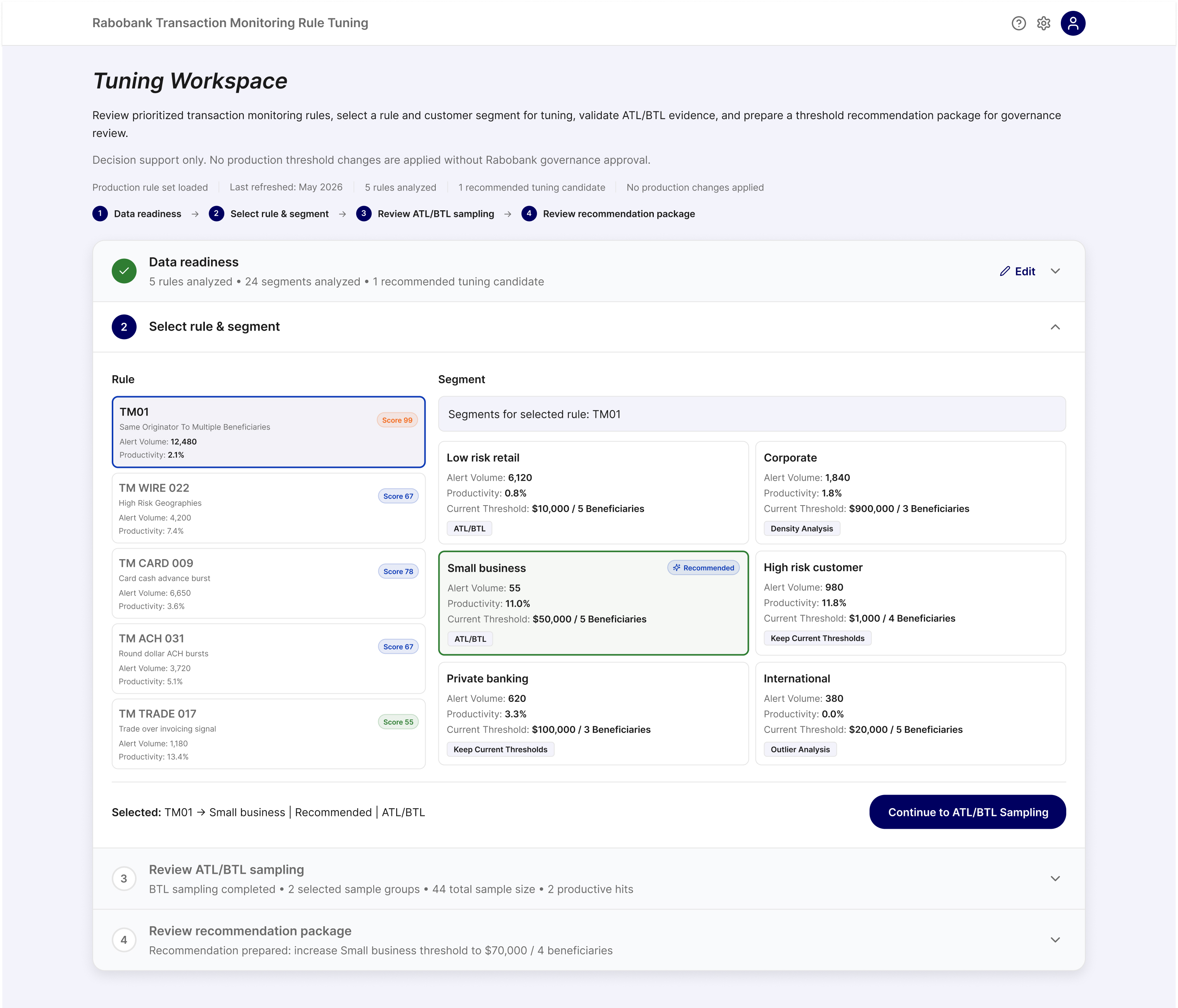
Rule and segment selection in one view
- Rules listed on the left with alert volume, productivity, and a priority score — TM01 (Same Originator to Multiple Beneficiaries) is the recommended candidate
- Segments on the right scoped to the selected rule — Small business is highlighted as the tuning target
- The two-part model reflects an SME requirement: recommendations must be made at the rule/segment level, not rule-only
- A single CTA moves the analyst forward once a selection is confirmed
Step 3
ATL/BTL sampling: evidence without overload
The sampling table exposes the evidence behind the recommendation without a dense analytical dashboard. Two sample groups for TM01 Small business: population, sample size, and productive hits. Enough to validate the threshold direction.
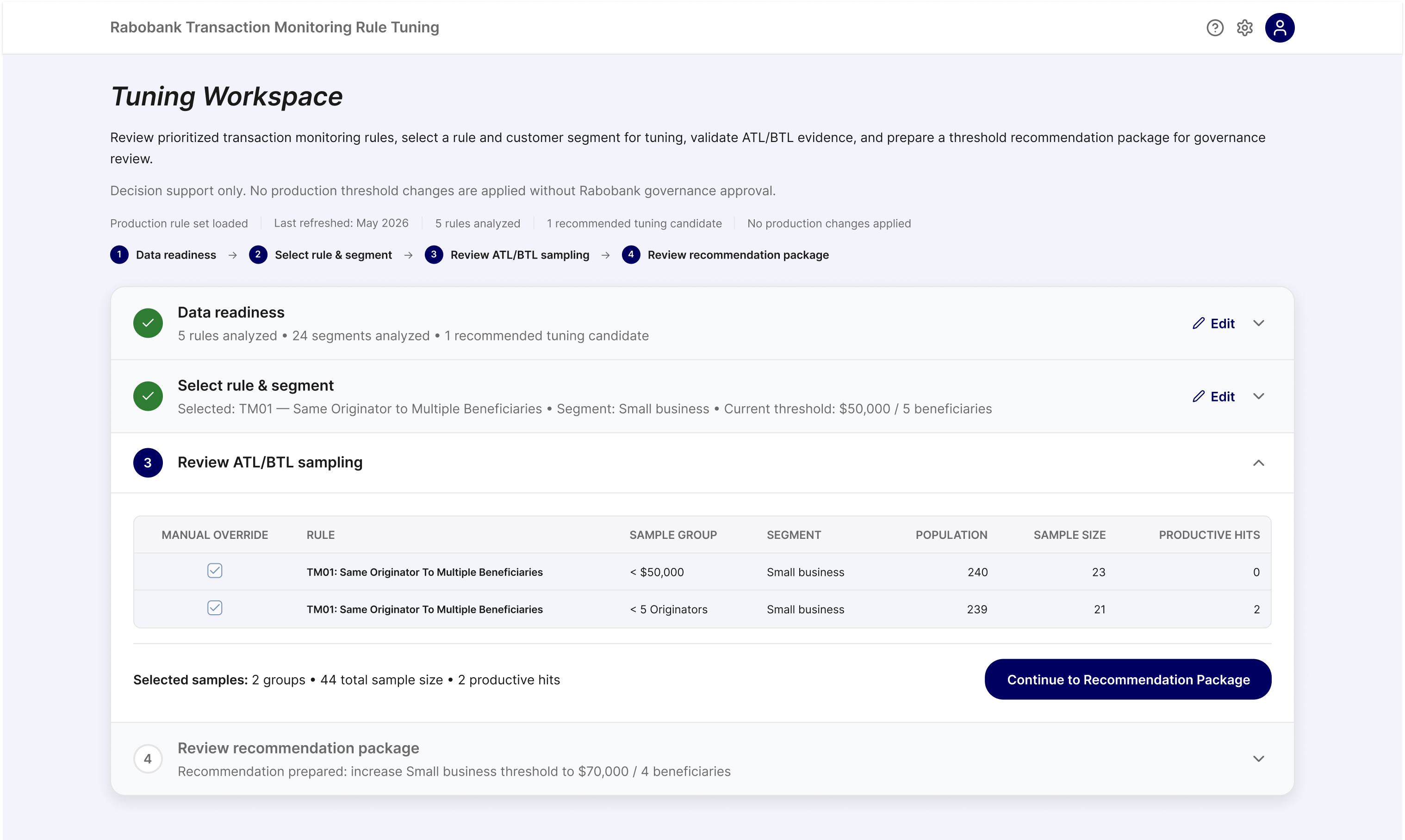
2 groups, 44 total sample size, 2 productive hits
Step 4
The recommendation package and governance submission
Current vs. recommended state side-by-side: alerts reduced −25, escalations +2, productivity lift +16 pts. A threshold tuning chart overlays alert outcomes to explain the direction. Submitting sends the package to Rabobank governance: no threshold changes apply in production until approval is granted.
- The confirmation message states that no threshold changes have been applied in production
- All four steps show green checks — work done, authority still held by Rabobank governance
- Avoids a misleading “success” pattern that could imply implementation rather than submission
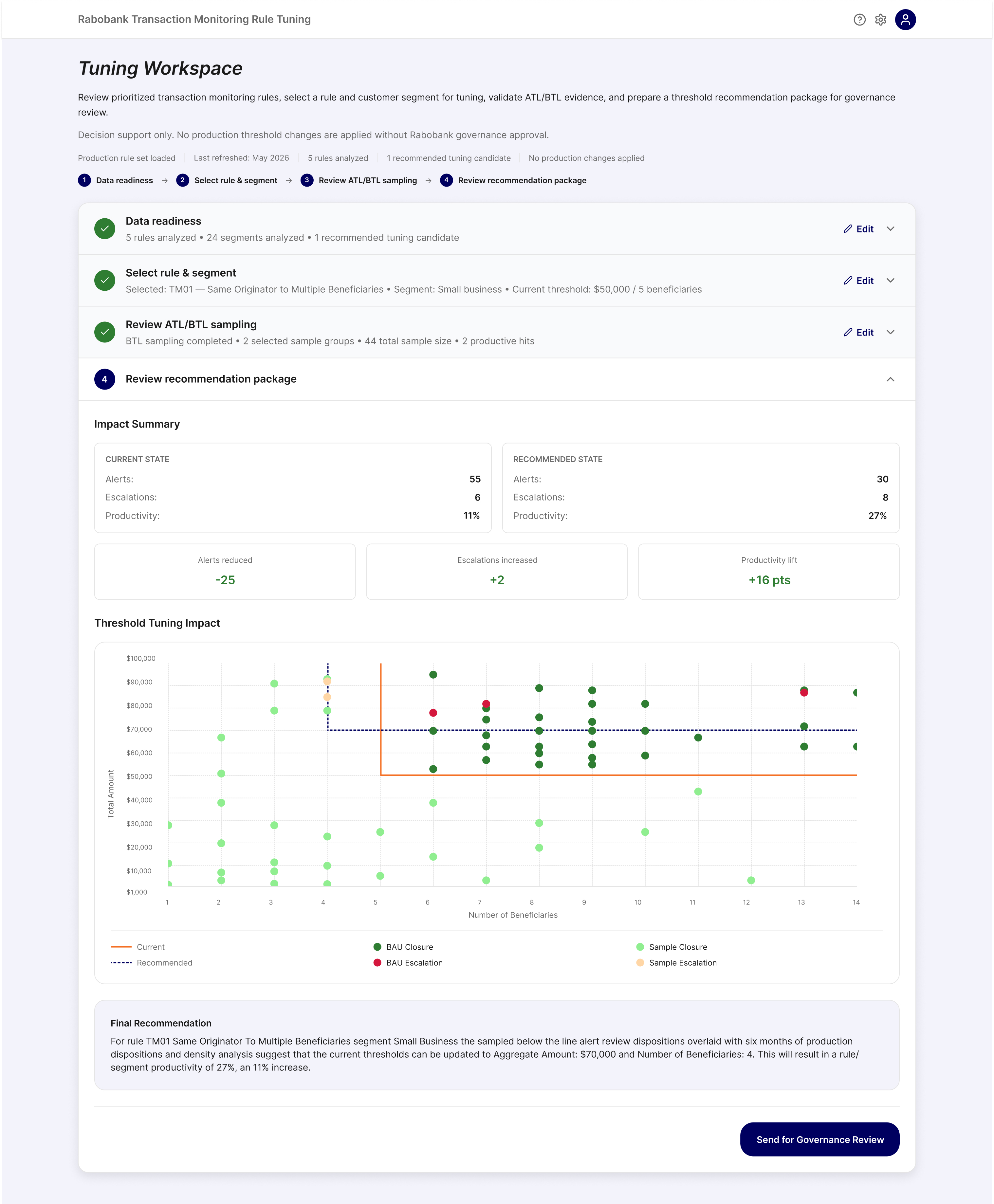
Recommended: increase Small business threshold to $70,000 / 4 beneficiaries — 27% productivity lift
WhatIdesigned
- Turned fragmented Excel-based requirements into a coherent four-step product story
- Made the back-end data pull visible in the UI without adding an upload screen
- Framed every output as a recommendation — no autonomous AI action implied anywhere in the interface
- Delivered a credible five-minute RFP walkthrough for both business and compliance stakeholders
- Resolved the rule/segment selection disconnect visible in earlier layout concepts
- Validated the accordion model over a dashboard-first approach for a guided demo